
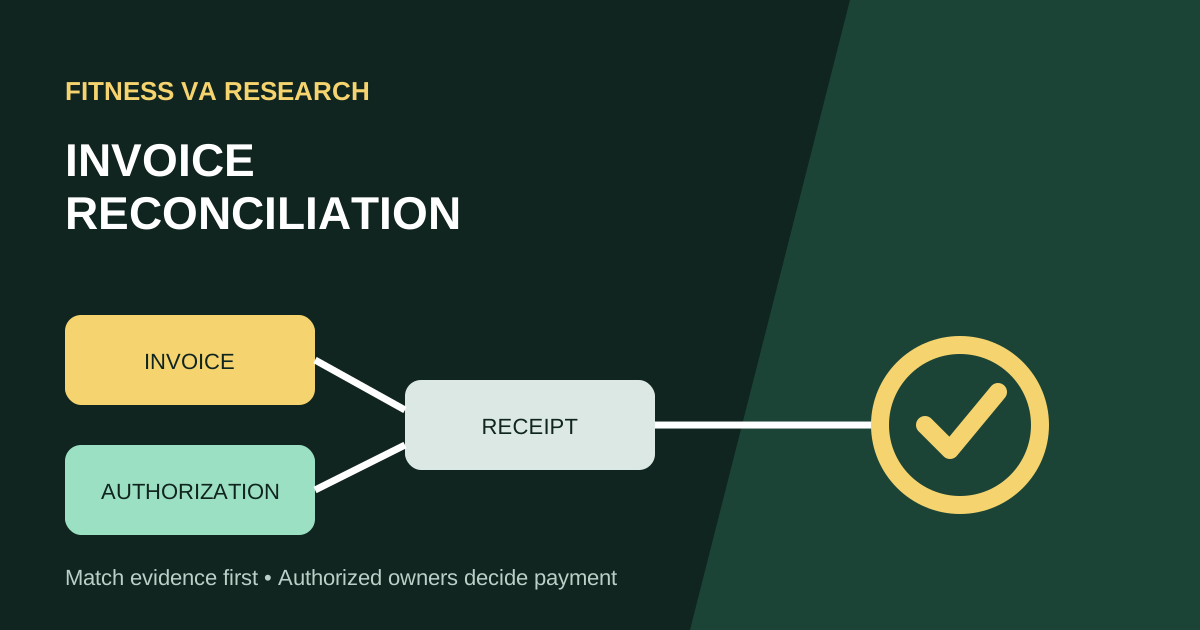
Supporting documents show the items recorded in business books is the headline reference in this brief.
Fitness businesses buy equipment, software, cleaning, maintenance, marketing, education, and professional services. An invoice can look familiar while carrying the wrong location, duplicate period, changed quantity, or unapproved bank detail. Reconciliation creates a structured comparison before an authorized person decides whether and how to pay.
This brief defines what a fitness virtual assistant can prepare: source collection, field normalization, matching, duplicate checks, exception summaries, and post-payment record updates. The VA should not approve their own work, change vendor payment instructions without independent verification, decide tax treatment, or represent that an administrative match is an audit.
Method and source scope
We reviewed IRS Publication 583, IRS small-business recordkeeping guidance, and the Federal Trade Commission's Start with Security guide. Sources were checked on September 19, 2026. IRS materials explain why supporting documents and orderly records matter for federal tax records. FTC guidance supplies practical security principles. Neither source dictates a complete accounts-payable control system for every fitness business.
The unit of review is one invoice obligation. Record vendor identity from the approved vendor master, invoice number, invoice date, service period, purchase or contract reference, receiving evidence, subtotal, tax or fee lines, total, currency, location or cost center, due date, payment method category, and approval owner. Store the original invoice in the controlled repository and use a stable link in the queue.
Requirements vary with accounting method, tax jurisdiction, contract, entity structure, insurer, and adviser guidance. The owner and accountant define the chart of accounts, retention schedule, approval limits, and tax treatment. The reconciliation record should preserve facts for those decisions rather than invent them.
The evidence stack
| Record | Question answered | What it cannot answer alone |
|---|---|---|
| Approved vendor master | Is this the recognized vendor profile? | Whether the current invoice is valid |
| Contract or purchase approval | What was authorized? | Whether goods or services were received |
| Receiving or service evidence | What was delivered and when? | Correct accounting or payment approval |
| Invoice | What the vendor requests | Whether the request is accurate |
| Payment record | What was initiated or settled | Whether it was properly authorized |
| Ledger entry | How the business recorded it | Whether source documents were complete |
A “match” should describe exact comparisons. Two-way matching may compare invoice with an approved order or contract. Three-way matching can add receiving evidence. Recurring subscriptions may use plan, approved seat count, billing period, and change log. Maintenance may require a work-order closeout. Define the evidence appropriate to each vendor category.
Do not force all vendors through fields that do not apply. Use “not applicable under policy” with the relevant rule rather than leaving a blank that looks accidental. Never mark missing evidence complete based on familiarity with a vendor. Repeated vendors can create complacency precisely because invoices look routine.
Normalize without rewriting source records
Capture data exactly, then add normalized fields separately. Preserve leading zeros in invoice numbers, original currency, tax labels, and stated service period. If the invoice contains an apparent typo, flag it; do not alter the original. Record extraction confidence when software reads documents automatically.
Duplicate checks should compare more than invoice number. Vendors can reuse numbers or change formats. Compare vendor identity, amount, date, service period, purchase reference, and attachment hash where available. A possible duplicate is an exception for review, not proof of wrongdoing.
Allocate locations or cost centers only under an approved rule. If one invoice spans locations, preserve the basis of allocation. A VA may calculate the approved split and show the arithmetic, but the responsible owner or accountant approves classification. Avoid burying uncertain amounts in a miscellaneous category.
Protect payment-change workflows
A request to change bank details, payment destination, or contact identity should leave the ordinary invoice queue and enter a separately controlled verification process. Do not verify the change using contact details supplied only in the same message. Use the business's trusted vendor record and an independent approved channel. Record who verified, when, by what route category, and who approved the master-data change.
Separate duties where practical. The person who creates or changes a vendor should not be the sole approver of the first payment. The person who prepares a payment should not be its only reviewer. Small businesses may have limited staff, but they can still use owner approval, bank controls, notifications, and retrospective review.
Do not place bank details, tax identifiers, or login information in an open project board. Restrict original files and exports, mask reporting, and remove temporary copies under policy. If suspicious activity or misdirection is suspected, escalate immediately through the incident and financial-provider route; do not investigate by replying to the questionable sender.
Run a gated reconciliation
Use an intake gate, matching gate, approval gate, and closeout gate. Intake checks document integrity, vendor identity, period, due date, and duplicate indicators. Matching compares the invoice with the defined supporting evidence. Approval presents verified fields, exceptions, and the exact requested decision to an authorized owner. Closeout confirms payment status and ledger handoff without assuming initiation equals settlement.
Exception categories should be specific: missing authorization, quantity variance, rate variance, tax or fee question, duplicate candidate, wrong location, service not confirmed, vendor detail change, credit expected, or document unreadable. Include the amount affected and source links. “Invoice problem” is too vague for efficient review.
Set internal cutoffs ahead of due dates. The queue should show who owns the missing record and when escalation occurs. Do not use urgency to bypass a payment-detail verification. Late fees and service interruption are important context for the approver, not authority for the preparer to release funds.
Reconcile after the decision
After an approved payment, compare the payment reference, amount, currency, vendor, date, and status with the approval. Record partial payments, credits, voids, refunds, and failed transfers separately. Do not close an invoice because a payment was drafted. Settlement and bank reconciliation may occur later.
Link the final evidence packet to the accounting record according to the owner's procedure. Preserve corrections through adjusting or annotated entries rather than deleting history. When the ledger differs from the invoice, record the approved reason. An unexplained difference should remain open.
For recurring vendors, review trend exceptions: unexpected price changes, new fees, seat growth, overlapping service periods, unused services, or repeated credits. These indicators support owner review; they do not prove waste or error. Contract interpretation and cancellation decisions remain with authorized people.
Measures, audit, and limits
Useful measures include invoices received, reconciled before cutoff, exceptions by category, duplicate candidates, master-data changes, approvals completed, and closeouts matched to settled payments. State the period and denominator. Separate invoice volume from dollar value, and avoid publishing sensitive vendor detail.
Audit a sample from original document through ledger reference. Confirm the vendor master version, supporting record, calculation, approver, payment reference, and retained document. Test whether links remain accessible to authorized users and whether permissions are excessive. Record discrepancies rather than editing them away.
This workflow cannot establish that services were satisfactory, a contract is enforceable, tax treatment is correct, or fraud is absent. Documents can be forged, approvals can be compromised, and systems can be wrong. Qualified accountants, lawyers, security professionals, and financial institutions own questions in their domains.
The decision-grade conclusion is deliberately narrow: the invoice was compared with identified source records; differences were presented; an authorized owner made the recorded decision; and the resulting transaction was reconciled by the stated method. That conclusion is useful because it can be tested.
Sources
- Publication 583, Starting a Business and Keeping Records, Internal Revenue Service, checked September 19, 2026.
- Recordkeeping, Internal Revenue Service, checked September 19, 2026.
- Start with Security: a guide for business, Federal Trade Commission, checked September 19, 2026.
For adjacent evidence design, see the equipment inspection exception research and the Fitness VA bookkeeping service. Book a free call to map reconciliation support while keeping payment approval and accounting judgment with the responsible owners.
Frequently asked questions
What does the Supporting documents show the items recorded in business books figure mean on this page?
It is the headline benchmark described in the article and attributed to the listed primary source. Read the definition, date, population, and limits before applying it to a fitness business.
How should a fitness team use this research?
Use it as a documented reference beside the team's own operating records. It does not replace local data, coaching judgment, medical advice, or a qualified professional's decision.
What can a fitness virtual assistant do with the source record?
An assistant can maintain source links, verification dates, definitions, and exception queues. The business owner or qualified professional keeps policy, coaching, health, legal, and financial decisions.
Discuss your fitness administration workflow
Bring the current process, handoff points, and exceptions. We will help you decide which administrative work is suitable for remote support.
Book a free call