
Keep business records for as long as they may be needed is the headline reference in this brief.
A payment-dispute inbox is not a refund policy. It is an evidence problem with a deadline. A member may say a charge was unfamiliar, duplicated, made after cancellation, or different from what they expected. The payment processor may use a different label, and the studio may have records in several systems. The useful administrative outcome is a reliable packet that lets an authorized owner respond consistently. It is not an automatic conclusion that either side is right.
This brief describes how a fitness virtual assistant can assemble that packet while keeping financial, legal, and customer-service judgment with the business. The method supports Fitness VA's bookkeeping, client-management, and inbox workflows because it reduces searching and makes missing evidence visible. It does not interpret card-network rules, promise a refund, contest a consumer's rights, or provide legal advice.
Method and source scope
We reviewed the Internal Revenue Service guidance on how long businesses should keep records, the Federal Trade Commission's overview of advertising and marketing rules, and the Consumer Financial Protection Bureau's consumer information about bank accounts and debit cards. Sources were checked on September 19, 2026. These sources establish broad recordkeeping, representation, and consumer-payment context. They do not create one universal fitness-membership dispute procedure.
The unit of analysis is one questioned transaction. For that transaction, record the member-facing descriptor, amount, currency, transaction time, processor reference, membership or order reference, issue-received time, response deadline, and current owner. Link controlled source records rather than pasting unnecessary payment or identity data into a general task board. Label each fact with its source and retrieval time.
The IRS says record retention depends on the action, expense, or event a document records and on the period of limitations that applies. That is a reason to adopt a written retention schedule, not permission to keep everything forever. The FTC resource emphasizes that claims and marketing practices are governed by applicable rules; it is not a decision about an individual dispute. CFPB materials explain consumer-facing payment concepts, but the business must still follow its processor agreement, card-network process, contract, policy, and applicable law.
Evidence model
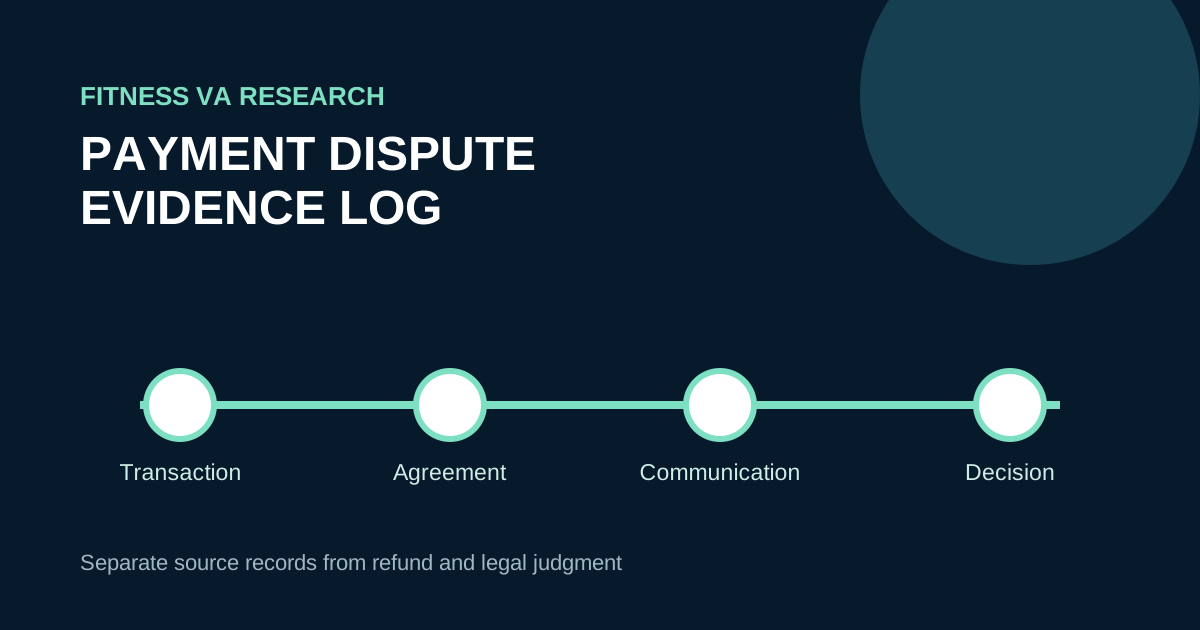
| Evidence layer | Examples | What it cannot prove alone |
|---|---|---|
| Transaction | Processor ID, amount, time, status | That the member authorized or recognized the charge |
| Agreement | Plan version, acceptance record, effective date | That every term was lawful or clearly presented |
| Service | Booking, check-in, access, delivery record | That a disputed payment must be retained |
| Communication | Cancellation request, reply, confirmation | Intent beyond the actual message |
| Adjustment | Credit, refund, reversal, write-off | Final settlement until systems reconcile |
This layered model prevents a common error: treating one screenshot as the entire case. A processor receipt can show that a charge occurred. It does not show what the member saw when enrolling. A check-in can show an access event. It does not answer whether a later cancellation was processed correctly. A CRM note can document what a staff member recorded. It does not become independent proof merely because it is in the CRM.
Use source-neutral statuses: received, deadline confirmed, evidence gathering, owner review, action submitted, awaiting external outcome, reconciliation pending, and closed. Avoid labels such as fraudulent, invalid, or abusive unless an authorized person has made and documented that finding under the applicable process. The status should tell the next operator what work remains.
Build a transaction timeline
Start with the questioned transaction, then work backward and forward. Capture the offer or plan version in effect, enrollment or purchase event, any trial or renewal notice, the charge, relevant service events, cancellation or modification requests, staff responses, credits, refunds, and the dispute notice. Use system timestamps with time zones. If systems disagree, preserve both values and explain the discrepancy instead of silently choosing one.
Separate observed records from statements. “Processor shows settled at 14:03 UTC” is an observation. “Member did not cancel” is a conclusion unless the complete cancellation channel has been checked. “CRM has no cancellation note” means only that the searched CRM record lacks such a note. Email, form, phone, platform, and in-person routes may exist. Record which routes were searched and the limits of access.
Preserve the version of any relevant policy, price, or disclosure that applied at the event time. A current website page may differ from the page a member saw. Do not recreate historical terms from memory. If versioned evidence is unavailable, mark it unavailable and send that gap to the decision owner.
Control sensitive data
A dispute packet should use the minimum data necessary. Mask full account and card details. Do not copy security codes, passwords, identity documents, or complete processor exports into a shared spreadsheet. Use role-based access and stable references to the system of record. A VA should be able to see task state without gaining access to every underlying financial field.
Create a defined retention and deletion rule with the owner, accountant, processor requirements, and qualified advisers. “Keep business records as long as needed” is not a fixed number. Different records can have different periods, and a pending dispute, audit, or legal hold may change normal deletion. Log deletion and access changes so the evidence chain remains understandable.
If a member sends sensitive information through an unsuitable channel, do not replicate it into more systems. Follow the business's incident and secure-handling procedure, restrict access, and direct future submissions to the approved channel. The administrative role is containment and routing, not investigation beyond authority.
Run review gates
Use four gates. The identity-and-scope gate confirms the transaction without collecting excess data. The evidence gate confirms that each required record has a source, date, and status. The decision gate gives the owner a short brief containing verified facts, missing information, relevant policy version, deadline, and available procedural actions. The reconciliation gate confirms that the approved action appears consistently in the processor, accounting record, membership platform, and member communication.
Do not let a templated response outrun the decision. A VA may prepare a draft, but refund, acceptance, challenge, account restriction, fee, and legal-position decisions require the authorized owner. Do not pressure a member to withdraw a dispute, make unsupported claims about consequences, or describe a provisional processor event as final.
Deadlines need two fields: the external deadline and the internal owner-review cutoff. Set the internal cutoff early enough for missing records and corrections. Escalation should contain the amount, external reference, due time, what was checked, what is missing, and the named decision requested. Repeated reminders without a decision owner are not a control.
Measure reliability without gaming outcomes
Useful measures include cases received, packets ready before the internal cutoff, median evidence-gathering time, missing-record categories, reconciliations completed, and cases reopened because systems disagreed. Always state the denominator and period. Separate member inquiries from formal processor disputes and separate provisional outcomes from final outcomes.
Do not treat a high challenge rate or a high win rate as proof of good administration. Volume may reflect growth, descriptor confusion, billing design, seasonal pauses, or a small number of repeated errors. A decision to refund may be a service choice rather than an admission. A processor outcome does not necessarily determine every contractual or legal question.
Audit a sample from notice through reconciliation. Check that timestamps retain time zones, evidence links open for authorized reviewers, policy versions match the event, owner decisions are attributable, and member messages match the approved action. Preserve corrections as corrections rather than overwriting the earlier record.
Decision-grade conclusion
A strong payment-dispute log makes five things visible: the exact transaction, the applicable historical context, the records checked, the unknowns, and the authorized decision. It reduces preventable delay while respecting the boundary between administrative preparation and consequential judgment. Its value is reproducibility, not a promise that every dispute will resolve in the business's favor.
Limits remain. Records can be incomplete, clocks can differ, descriptors can confuse members, and third-party platforms can change status after a packet is prepared. Requirements vary by jurisdiction, payment method, processor, and agreement. The business should obtain qualified advice for legal or accounting questions and should update the workflow when those requirements change.
Sources
- How long should I keep records?, Internal Revenue Service, checked September 19, 2026.
- Advertising and marketing on the internet: rules of the road, Federal Trade Commission, checked September 19, 2026.
- Bank accounts and debit cards, Consumer Financial Protection Bureau, checked September 19, 2026.
For related implementation context, see the membership freeze workflow research and the Fitness VA bookkeeping service. Book a free call to map evidence collection while keeping payment decisions with the responsible owner.
Frequently asked questions
What does the Keep business records for as long as they may be needed figure mean on this page?
It is the headline benchmark described in the article and attributed to the listed primary source. Read the definition, date, population, and limits before applying it to a fitness business.
How should a fitness team use this research?
Use it as a documented reference beside the team's own operating records. It does not replace local data, coaching judgment, medical advice, or a qualified professional's decision.
What can a fitness virtual assistant do with the source record?
An assistant can maintain source links, verification dates, definitions, and exception queues. The business owner or qualified professional keeps policy, coaching, health, legal, and financial decisions.
Discuss your fitness administration workflow
Bring the current process, handoff points, and exceptions. We will help you decide which administrative work is suitable for remote support.
Book a free call