
Commercial email must include a clear opt-out mechanism is the headline reference in this brief.
A fitness lead record often begins with a form, event list, referral, direct message, phone call, or imported file. Those origins are not interchangeable. A CRM field that says “opted in” can hide the channel, wording, date, scope, and source needed to understand what actually happened. A reliable contact-permission record preserves those details and makes suppression operational.
This brief focuses on administrative evidence, not a universal legal answer. A fitness virtual assistant can maintain source fields, apply approved suppression rules, route ambiguous records, and audit campaign inputs. The business and qualified advisers must decide what permission is required for a particular channel, message type, audience, technology, and jurisdiction.
Method and authoritative context
We reviewed the Federal Trade Commission's CAN-SPAM compliance guide, the Federal Communications Commission's telemarketing and robocall resources, and the National Institute of Standards and Technology Privacy Framework. Sources were checked on September 19, 2026. The federal materials show that channel and context matter. They do not make one generic consent checkbox sufficient for every contact.
Use one contact-channel-purpose combination as the unit of analysis. A person can have different states for email, manually dialed calls, automated calls, and text messages, and for service versus marketing communications. Record the source event, exact disclosure or approved form version, affirmative action if any, timestamp with time zone, capture system, campaign or location, and later withdrawal or correction.
The FTC guide explains requirements for commercial email, including accurate routing information, identification rules, a valid postal address, and a clear opt-out method. The FCC explains telemarketing and robocall rules and complaint routes. The NIST Privacy Framework provides a risk-management structure rather than a legal determination. State laws, carrier rules, platform policies, and the facts of a campaign may add requirements.
A provenance-first schema
| Field | Operational purpose | Guardrail |
|---|---|---|
| Source type and source ID | Reconstruct where the lead originated | Do not use “website” when the exact form is known |
| Notice version | Preserve what was presented | Do not substitute today's page for the historical version |
| Action and timestamp | Record the observed event | Do not infer intent from silence |
| Channel and purpose | Scope downstream use | Do not copy one channel's state to all channels |
| Suppression state | Stop disallowed or unwanted outreach | Suppression must override campaign convenience |
| Evidence confidence | Expose missing or migrated data | “Unknown” is safer than invented certainty |
Keep consent evidence separate from lead qualification. Interest in a trial class does not automatically answer every marketing-permission question. A phone number needed to coordinate a requested appointment is not necessarily permission for every future campaign. A prior customer relationship can be relevant under some rules, but a VA should never convert it into a blanket status without an approved policy.
Imported lists require a source manifest. Record who supplied the list, when it was received, the represented collection method, fields included, intended use, and the owner who approved import. If evidence is missing, quarantine the list from outreach until the authorized reviewer decides what is permissible. Renaming an “unknown” field to “yes” during migration destroys provenance.
Make suppression a system behavior
An opt-out is not complete when someone writes a note. It is complete when the approved suppression state reaches every relevant sending path and survives future imports. Record the request channel, receipt time, affected address or number, scope, source message, processing time, and systems updated. Keep the minimum suppression token needed to prevent re-contact; deleting every trace can allow the same address to be re-imported.
Build suppression checks at campaign assembly, before send, and after platform synchronization. A spreadsheet prepared yesterday can be stale today. Compare the candidate audience with the current suppression source and produce a count of removed records. Do not export suppressed details into broadly shared reports; report counts and controlled references.
Handle ambiguous messages conservatively. “Stop,” “remove me,” and equivalent requests should enter the approved suppression workflow even when phrasing differs. Questions such as whether a request applies to a particular brand, location, or transactional message belong to the owner or adviser. The VA should preserve the message and pause avoidable outreach while the question is resolved.
Campaign readiness gates
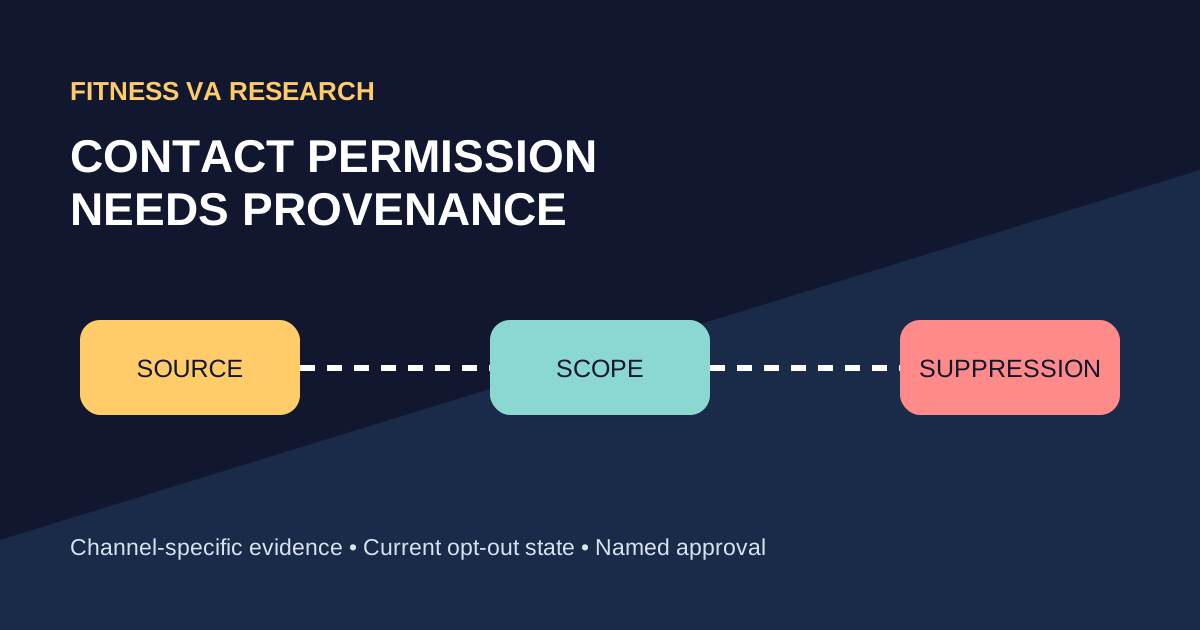
Use a source gate, scope gate, suppression gate, and approval gate. The source gate tests whether each record has traceable provenance. The scope gate compares channel and purpose with the approved policy. The suppression gate checks the live audience against the controlled exclusion source. The approval gate records the authorized campaign owner, audience definition, template version, and release time.
Automations need the same controls. A form-to-SMS workflow can start before a human opens the CRM. Test trigger conditions, data mapping, duplicate handling, time zones, suppression precedence, and failure alerts. A disabled campaign in one platform does not necessarily disable connected tools. Maintain an inventory of every system capable of sending.
Avoid sensitive segmentation unless the business has approved a legitimate need and safeguards. Fitness inquiries can reveal interests related to health, disability, pregnancy, age, or other personal circumstances. Do not infer diagnoses or target people based on sensitive assumptions. Minimize free-text copying and restrict access to intake details.
Audit the evidence chain
Select a sample from each lead source and trace it forward. Can the reviewer open the historical form or notice version? Does the timestamp retain a time zone? Is the channel-specific state preserved? Did a later opt-out reach all senders? Were duplicates merged without losing the most restrictive state? Record failures by type and owner.
Useful operational measures include records with complete provenance, records quarantined, suppressions processed within the internal target, campaigns checked before launch, and post-send complaints by source. Publish counts with denominators and date ranges. Do not claim a complaint rate proves legal compliance; low complaints can coexist with weak records.
When an integration fails, preserve both source and destination evidence. Record the event ID, attempted payload fields, error response, retry state, and whether outreach occurred. Never resolve a synchronization error by manually setting permission to an assumed value. Repair mapping under change control and retest with non-production or approved test records.
Roles and escalation
A VA can normalize source labels, link historical artifacts, process approved opt-out steps, remove suppressed records from draft audiences, prepare exception queues, and document tests. The campaign owner defines purpose and audience. Legal or compliance advisers interpret requirements. Platform administrators control integrations. One person may hold several roles, but the record should say which authority supported each decision.
Escalate missing notice versions, third-party list provenance, conflicting channel states, failed suppression synchronization, unclear opt-out scope, and any campaign involving automated calls or texts without approved evidence. An escalation should state the planned campaign, channel, audience size, earliest send time, verified facts, missing evidence, systems affected, and exact decision needed.
Never make compliance claims in public copy based only on process completion. “Audience checked against suppression list at 09:00 UTC” is a verifiable operational statement. “Fully compliant” is a broad conclusion that may require legal review across multiple rules and jurisdictions.
Decision-grade conclusion and limits
The strongest fitness lead contact record does not reduce permission to one checkbox. It preserves who supplied the data, what was presented, what action occurred, which channel and purpose are in scope, and what later changed. It makes suppression durable across tools and gives ambiguous cases to an accountable owner before outreach.
No administrative record guarantees that permission is legally sufficient. Source evidence can be missing, platform logs can be incomplete, disclosures can be defective, and requirements can change. The business should maintain an approved policy, seek qualified advice, and retest integrations. The VA's contribution is disciplined provenance and timely exception routing.
Sources
- CAN-SPAM Act: a compliance guide for business, Federal Trade Commission, checked September 19, 2026.
- Telemarketing and robocalls, Federal Communications Commission, checked September 19, 2026.
- NIST Privacy Framework, National Institute of Standards and Technology, checked September 19, 2026.
For related evidence design, see the fitness lead source attribution research and the Fitness VA client management service. Book a free call to map contact administration while keeping compliance decisions with the responsible business.
Frequently asked questions
What does the Commercial email must include a clear opt-out mechanism figure mean on this page?
It is the headline benchmark described in the article and attributed to the listed primary source. Read the definition, date, population, and limits before applying it to a fitness business.
How should a fitness team use this research?
Use it as a documented reference beside the team's own operating records. It does not replace local data, coaching judgment, medical advice, or a qualified professional's decision.
What can a fitness virtual assistant do with the source record?
An assistant can maintain source links, verification dates, definitions, and exception queues. The business owner or qualified professional keeps policy, coaching, health, legal, and financial decisions.
Discuss your fitness administration workflow
Bring the current process, handoff points, and exceptions. We will help you decide which administrative work is suitable for remote support.
Book a free call