
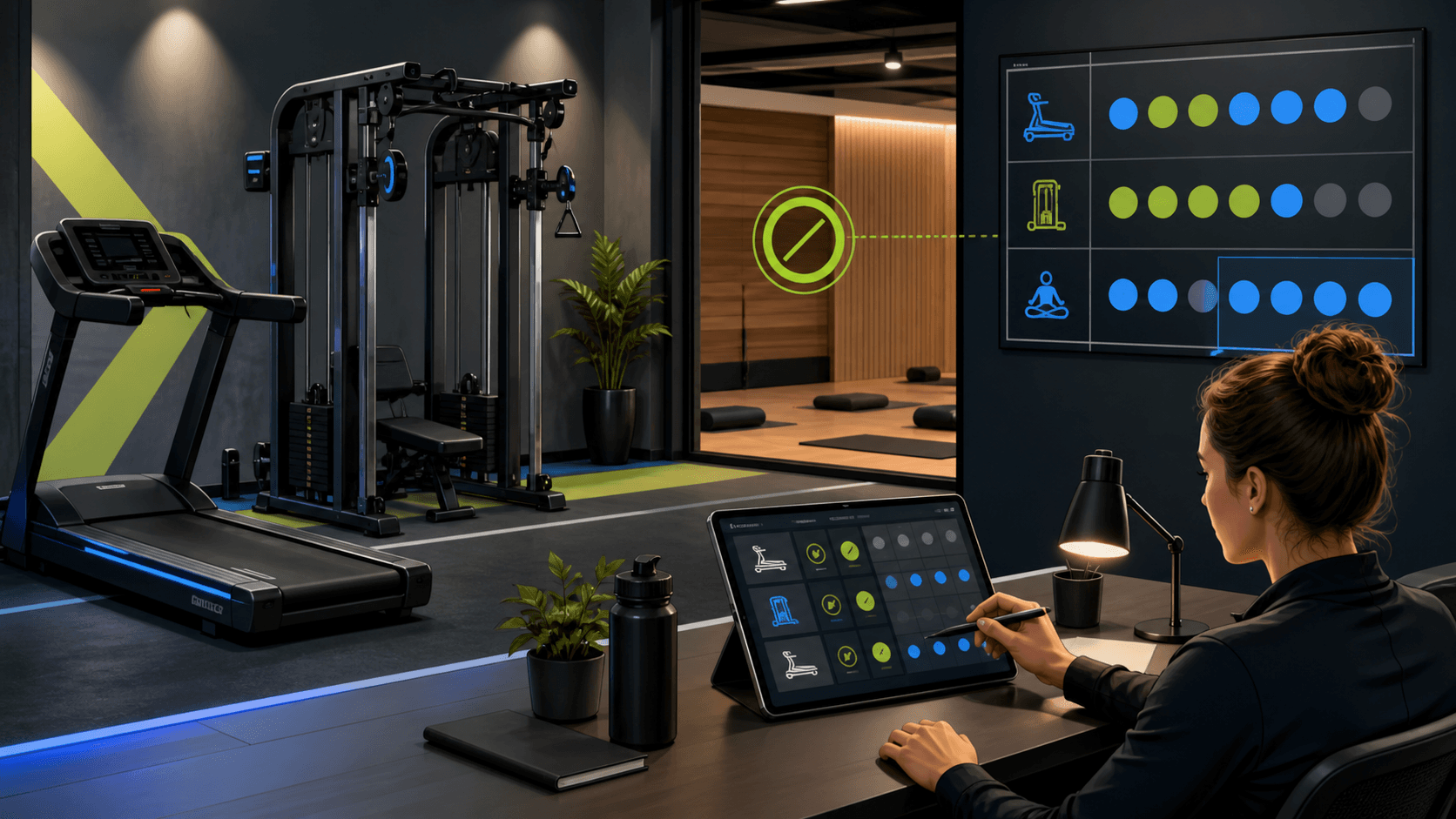
Available capacity is conditional on usable equipment is the headline reference in this brief.
When a treadmill, cable station, bike, or set of weights is unavailable, how should a fitness business change the capacity record for the class that depends on it? This research question is operational, but it has a safety boundary. A class roster can show planned places; it cannot certify that equipment is safe, that a substitution is suitable for every participant, or that a room can be used in a new configuration. The useful evidence links a maintenance event to a scheduling consequence without collapsing those decisions.
Method and evidence scope
The review uses OSHA's machine-guarding standard as a reminder that equipment hazards require controlled decisions, the Consumer Product Safety Commission's referenced product-safety communication standard for hazard communication context, and NIST's standards guidance for understanding why a cited standard should be read in its own scope. These are not a repair manual or a universal fitness-facility policy. The article translates their evidence and communication principles into a record design for gyms and studios. Facts, inferences, and local decisions are kept separate.
The proposed unit is an equipment availability interval: the period from an authorized unavailable status to an authorized return-to-use status. It is not the same as a technician's arrival time, a staff report, or the number of classes affected. Measuring the interval this way prevents a business from restoring capacity in the spreadsheet before a qualified person has released the equipment.
The route's direct references are OSHA's machine-guarding standard at https://www.osha.gov/laws-regs/regulations/standardnumber/1910/1910.212, the CPSC product-safety communication reference at https://www.cpsc.gov/s3fs-public/pdfs/ANSI-Z535-4.pdf, and NIST standards guidance at https://www.nist.gov/standardsgov/what-we-do. They are claim-relevant but limited: OSHA addresses a defined workplace standard, the CPSC document concerns hazard communication, and NIST explains standards context. None is evidence that a particular treadmill, cable station, room, or class is safe or unsafe.
What a capacity record can and cannot say
OSHA's standard demonstrates why an operator should not use a calendar or visual inspection alone to resolve a hazard question. CPSC's communication standard shows the value of consistent, understandable safety messaging. NIST's standards material cautions against treating a standard excerpt as a complete operating rule outside its scope. Together they support a conservative workflow: identify the affected asset, restrict use as needed under local procedure, document the communication, and record the owner of the return decision.
An administrative table can include asset identifier, location, unavailable timestamp, affected service, planned capacity, revised capacity, member communication status, maintenance ticket, and release timestamp. “Revised capacity” is a scheduling value, not a safety clearance. If a class can proceed with fewer stations, the responsible coach or manager decides whether that format is appropriate. If equipment is returned, the person authorized by the business's safety procedure records the release.
| Evidence | What it measures | What it does not prove |
|---|---|---|
| Asset status | Whether the item is marked available | That it is safe without the required review |
| Planned capacity | Seats offered before the event | Actual attendance or equipment use |
| Revised capacity | Seats offered after an operational change | That every participant can use the substitute |
| Maintenance interval | Time between status changes | Cause, cost, or service quality |
| Communication log | Who received the change | That the message was understood |
Connecting downtime to a class record
Start with the class schedule as the denominator: list each session that overlaps the unavailable interval and identify the equipment dependency. Then distinguish direct impact from possible impact. A strength class requiring six cable stations may have a direct capacity constraint when two are unavailable. A mobility class in the same room may have no direct constraint but could face a space change. The distinction should be recorded rather than guessed from the room name.
A VA can join records by stable asset and class identifiers, flag sessions whose revised capacity is missing, and prepare a member-notification queue. The VA can also compare planned seats with attendance after the event, but should not label a lower attendance as a maintenance loss without evidence. Cancellations, weather, instructor absence, and member choice are competing explanations. An evidence table can expose the timing without pretending to identify causation.
The comparison should retain the class format and room configuration because a replacement exercise can alter the number of stations without changing the headline class name. If the record cannot identify that configuration, report the session as affected but leave the mechanism unknown. That is a useful finding: it identifies a missing field instead of manufacturing a precise capacity impact.
Communication and role boundaries
Member-facing copy should say what changed, which session is affected, and what action the member can take under the business's policy. It should not describe an unverified hazard in sensational terms or promise that a substitute is suitable for a particular person's body or condition. A coach or qualified professional handles questions about exercise modification. A manager owns the commercial and scheduling response. The record should show those handoffs instead of making the assistant the final authority.
Limitations and conclusion
The capacity comparison should preserve the counterfactual the record can actually support. If two of eight stations are unavailable, the table may show that the planned station count changed from eight to six for sessions using those stations. It should not claim that attendance fell because of the outage unless the operator has a design that addresses other explanations. Compare affected sessions with their own planned capacity, and keep unaffected formats as context rather than pretending they are a perfect control group. This is especially important when a coach changes the format, moves rooms, or offers a non-equipment alternative.
A useful review packet therefore contains the original class record, the asset event, the authorized capacity change, the communication timestamp, and the release evidence. Missing links should be visible as missing links. If a staff member remembers that a machine was unavailable but cannot identify the asset or interval, record the uncertainty and route it for follow-up. That discipline protects the historical record and tells the operator which system field would make the next capacity review more reliable.
The sources do not evaluate a fitness studio's machines, staffing, lease, insurance, or local rules. OSHA's standard has a defined scope, CPSC's document is a communication reference, and NIST does not approve a specific capacity formula. The proposed interval also depends on reliable timestamps and an actual return-to-use procedure. Without those, a downtime report is only a maintenance note, not a capacity study.
The evidence-led conclusion is that usable capacity should be treated as conditional: a class record may be revised when equipment is unavailable, but it should remain linked to the maintenance event and the authorized release. This preserves a clean chain from asset status to schedule decision to member communication. It also keeps administrative coordination from becoming an unsafe equipment or exercise judgment.
Frequently asked questions
What does the Available capacity is conditional on usable equipment figure mean on this page?
It is the headline benchmark described in the article and attributed to the listed primary source. Read the definition, date, population, and limits before applying it to a fitness business.
How should a fitness team use this research?
Use it as a documented reference beside the team's own operating records. It does not replace local data, coaching judgment, medical advice, or a qualified professional's decision.
What can a fitness virtual assistant do with the source record?
An assistant can maintain source links, verification dates, definitions, and exception queues. The business owner or qualified professional keeps policy, coaching, health, legal, and financial decisions.
Discuss your fitness administration workflow
Bring the current process, handoff points, and exceptions. We will help you decide which administrative work is suitable for remote support.
Book a free call