
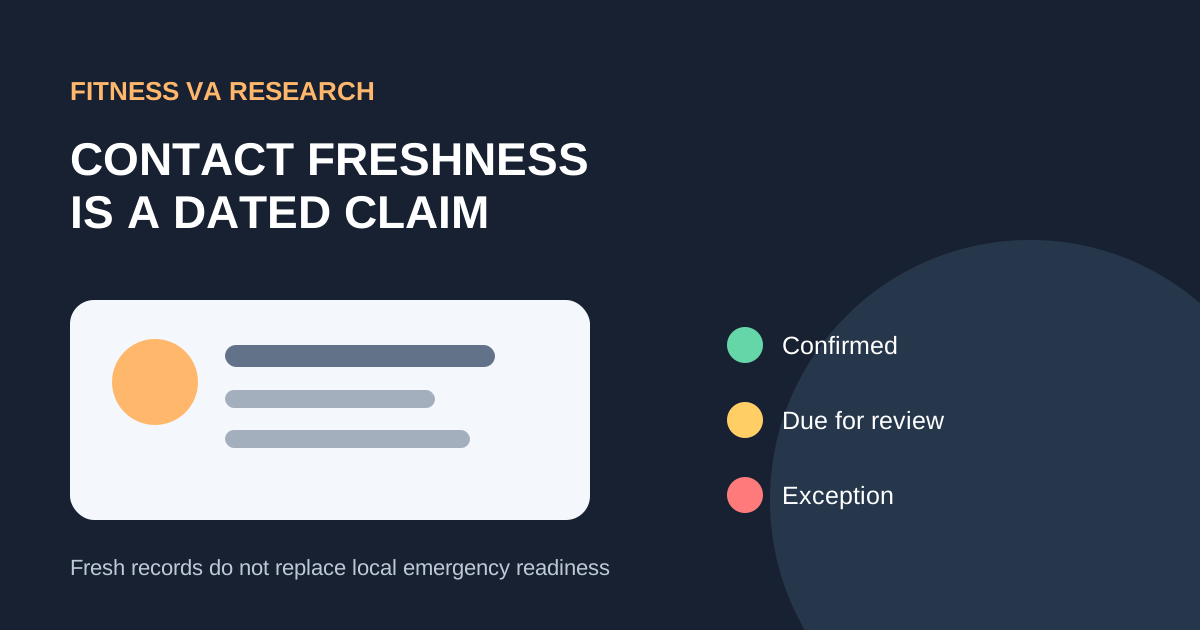
Emergency plans should define how employees report emergencies is the headline reference in this brief.
An emergency contact field can be filled and still be unusable. The number may be old, the relationship may have changed, the member may not know how it will be used, or staff may not know where to find it. Conversely, a recent confirmation does not prove that the contact will answer or that the business is prepared for an emergency. A freshness audit should measure the record it can actually observe.
This brief defines a narrow administrative role for a fitness virtual assistant: maintain approved fields, send neutral confirmation requests, record responses, protect access, and route exceptions. It does not ask a VA to make clinical decisions, design an emergency action plan, determine legal sufficiency, or contact someone during an emergency without the business's procedure.
Method and source scope
We reviewed OSHA's emergency action plan standard, Ready.gov business emergency planning guidance, and the NIST Privacy Framework. Sources were checked on September 19, 2026. OSHA's standard addresses covered workplace plans and includes elements such as reporting procedures and employee roles. Ready.gov provides planning context. NIST provides privacy-risk management concepts. None says that every fitness member must supply the same contact fields.
The unit of analysis is one approved contact record for one defined purpose. Record the subject's internal identifier, contact name, relationship label supplied by the subject, approved phone or other route, collection source, last confirmation event, confirmation method, status, and access class. Avoid storing sensitive narrative in the freshness table.
Local law, youth-program rules, insurer expectations, employment obligations, facility procedures, and program design may alter what is required. The business and qualified advisers define the schema and emergency use. The audit only tests the approved schema against observable records.
Define “fresh” before measuring it
| Status | Evidence | Limitation |
|---|---|---|
| Confirmed | Subject affirmed the displayed or masked details on a stated date | Contact availability is not guaranteed |
| Updated | Subject supplied a change through an approved route | Accuracy beyond the submission is unknown |
| Declined | Subject declined an optional request | Not evidence of negligence or risk |
| Unreachable | Approved request could not be delivered | Reason is unknown |
| Due for review | Local review interval elapsed | Does not mean the data is false |
| Exception | Required handling needs owner review | VA must not invent resolution |
Choose a review interval based on the business's policy and risk analysis. Do not present an arbitrary interval as a legal mandate. Different populations or programs may require different processes, especially employees, youth participants, events, or services with separate agreements. Version the rule and record its approver.
Freshness should derive from a qualifying event, not merely a database edit. A migration timestamp is not a member confirmation. A staff member opening the record is not verification. Define which events count: affirmative confirmation through an authenticated portal, a documented approved form, or a staff-assisted update under the identity-check procedure.
Ask without collecting excess data
Use a neutral message: explain why the business maintains the field, show a masked summary when practical, offer approved update and decline routes, and avoid alarmist language. Do not ask members to send sensitive information through ordinary email or direct messages if the business has a safer channel. Never ask for medical history as part of a contact refresh unless a separate approved process requires it.
Collect only what the policy needs. A contact's full address, date of birth, workplace, or medical relationship may be unnecessary. Free-text relationship labels can reveal personal information; use a limited optional field when possible. Do not attempt to verify a relationship through social media or public searches.
The subject should control ordinary updates. Contacting the named person merely to test the number can disclose membership or personal information and may create confusion. If the business wants direct verification, that consequential choice needs a reviewed script, purpose, authority, and privacy assessment.
Build operational gates
Use a policy gate, identity gate, update gate, and access gate. The policy gate confirms the correct program and field requirements. The identity gate follows the approved procedure before showing or changing data. The update gate records the source, time, previous-state reference, and new status without exposing old values in a broad log. The access gate confirms that only roles with a current need can retrieve the record.
Create an exception queue for undelivered requests, conflicting records, reported deceased contacts, youth account ownership questions, shared family accounts, and records that cannot be changed in the source system. The queue should contain the minimum facts, owner, deadline, and requested decision. It should not become a repository of personal explanations.
Test retrieval as well as entry. During an approved drill, can the responsible on-site role reach the correct record through the documented route if ordinary systems are unavailable? A remote VA may maintain data but may not be the right emergency-time dependency. The emergency plan should define local authority, backups, and escalation.
Privacy, retention, and corrections
Emergency contact data is personal information about both the subject and another person. Apply least access, log material changes, encrypt through approved systems, and avoid exports. When data is no longer required, follow the approved retention and deletion schedule. Do not keep old values indefinitely merely because storage is cheap.
Corrections should preserve accountability without making prior personal data widely visible. Record that a field changed, who processed the authorized change, the source event, and when. Store historical values only where the retention policy requires them and access is restricted. If data entered into the wrong record, follow the incident and correction procedure.
Be careful with reporting. Location-level freshness rates can help owners target administrative improvement. Small groups, named exception lists, or relationship categories can expose personal situations. Use thresholds and aggregation. Do not infer health, family stability, or emergency risk from an overdue confirmation.
Measure what the audit supports
Report records eligible for review, confirmed, updated, declined where optional, undeliverable, pending, and exception. Provide the denominator, program, policy version, and as-of time. Separate missing records from stale records. Separate an unsuccessful message delivery from a person's refusal.
Measure process timing: days from eligibility to first request, time to process updates, unresolved exceptions, and synchronization failures. These measures identify administrative bottlenecks. They do not measure emergency response quality. A high confirmation rate is not proof that the emergency plan works.
Audit a sample back to source events. Confirm that the event qualifies under policy, identity checks were recorded without excess detail, the system of record matches the audit table, access permissions are current, and suppression or communication preferences were honored. Record errors and correct them transparently.
Decision-grade conclusion and limits
A defensible emergency contact freshness audit states exactly what was confirmed, by whom, through which approved route, and under which policy version. It also shows missing, declined, undeliverable, and exception states instead of hiding them in a completion percentage. A VA can make this process timely and reproducible while the business controls safety and privacy decisions.
The audit cannot guarantee the contact is reachable, willing, appropriate, or legally authorized in a future event. It does not replace emergency services, on-site procedures, staff training, or a qualified review of obligations. Records can change immediately after confirmation. The honest conclusion is administrative: the stored record had the stated evidence and status at the audit time.
Sources
- Emergency action plans, 29 CFR 1910.38, Occupational Safety and Health Administration, checked September 19, 2026.
- Business emergency plans, Ready.gov, checked September 19, 2026.
- NIST Privacy Framework, National Institute of Standards and Technology, checked September 19, 2026.
For related operations research, see the fitness incident notification handoff brief and the Fitness VA client management service. Book a free call to map record maintenance while keeping emergency decisions with the responsible local team.
Frequently asked questions
What does the Emergency plans should define how employees report emergencies figure mean on this page?
It is the headline benchmark described in the article and attributed to the listed primary source. Read the definition, date, population, and limits before applying it to a fitness business.
How should a fitness team use this research?
Use it as a documented reference beside the team's own operating records. It does not replace local data, coaching judgment, medical advice, or a qualified professional's decision.
What can a fitness virtual assistant do with the source record?
An assistant can maintain source links, verification dates, definitions, and exception queues. The business owner or qualified professional keeps policy, coaching, health, legal, and financial decisions.
Discuss your fitness administration workflow
Bring the current process, handoff points, and exceptions. We will help you decide which administrative work is suitable for remote support.
Book a free call